Fishing for Food

California’s lake and streams. The place of countless bass derbies, catfish tournaments, and trout contests. Contestants come from around the country to participate in events that offer purses close to six figures in some cases. Eager fishers also bring their highly prized tourists dollars. An outcome not lost to state and county economic development strategists. It’s hard to recall that just six months ago Clear Lake reached flood levels that caused county officials to pass an ordinance banning motorized boats. The ban’s purpose was to protect shoreline properties. Clear Lake, a lake with 100-mile shoreline, was closed. Such an action hadn’t occurred in decades, if ever. The local fishing industry was not pleased. County officials convened public meetings. Economic arguments were interspersed with a few comments on public and environmental health. The public in this case translated to sport and recreational fishers. The ones who typically practiced catch and release rather than those that fished for food.

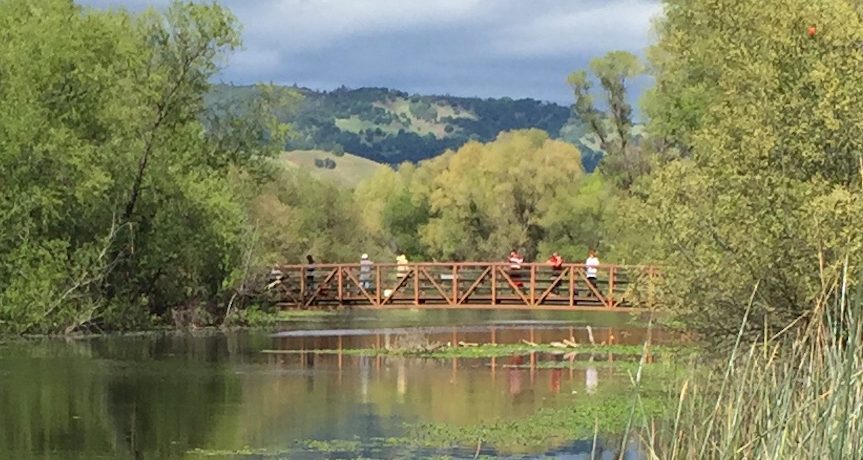
The rains resulted in a renewed abundance of fish in the lake. Although boaters were temporary restricted, shoreline fishers could now stock up on abundances of crappie, blue gill, catfish, bass and crawdads. I often passed groups of families fishing at the state park, also closed to campers due to the flood, with chests full of crappie and blue gills. Marveled at the rippling of the primrose as crawdads dove for cover with each step I took on the dock. Kids catching buckets full as their parents fished nearby. On streets closed due to flooding I watched a woman peacefully fishing at sunset atop the hood of a partially submerged car. In other areas I watched a group of fishers who appeared to be walking on water as they fished from a pubic dock awash nearly two inches. The flood brought an opportunity for folks who fish for food also referred to as subsistence fishers, to take advantages of abundances that collapsed during the drought. The public health effects of the bounty resulting for this particular extreme weather event is unclear, but I don’t believe that’s the main concern of the folks I observed. Fishing in this regard is not necessarily to put food on the table, but rather represents a way of life in which food is always available.
 

Environmentalism: Does Black Erase Green?

Environmental justice

Color of pollution

Pollution, poverty, and people

Environmental racism

These are just a few of Google’s suggestions in response to an “environment and people of color” search. But that wasn’t my first query. I initially searched for environmental magazines. The typical top ten high circulation publications filled my screen. Nature Conservancy, National Wildlife, Sierra, Missouri Conservationist and Mother Earth were the top five on the list. Although additional queries were made for key phrases such as outdoor, camping or recreation the results were pretty much the same. The magazines primarily focused on the role of particular folk as the guardians of wildlife and nature. Other folk, such as myself an African American, could only give voice to issues of injustice, inequality and degradation. Where is there space for me to talk about the hummingbirds that flutter less than two inches from my face while having morning tea and soaking up the sun’s rays? Or the deer that nestle under my fruit trees each evening? Or the catfish I catch in the Lake and Delta for food rather than sport? Regardless of my limited inclusion, I suspect nature is far more resilient that many folk acknowledge.

For instance, due to California’s drought, fires and floods my quality of life was directly affected as a result of the decimation of several of the state’s crops. Yesterday however, after a two-year hiatus, I happily resumed my summer tradition of gathering blackberries at the state park. Is human intervention necessary to address the effects of climate change, particularly in our current political climate? Most definitely! However to do so, a diversity of voices are also needed to reflect the diversity of relationships folks have with nature and the environment. Does Black erase green? Black, represented as poor and disconnected from nature, is a popular trope. Yet people of color are far most complex than depicted in thirty-second sound bites. The sooner we get more folks to acknowledge this reality, the sooner we can focus on collaboratively building bridges of inclusion rather than walls of exclusion.


Clear Lake California

Clear Lake is one of the oldest lakes in North America. Believed to be as old as 3 million years, the ancient lake holds a wealth of ecological and historical knowledge. Nestled in the state’s “best air quality” county, its 100 mile shoreline, abundant fish and majestic 68-square-foot glistening surface attracts countless visitors annually. A vital resource used by humans  as far back as 11,000 years ago, the lake continues to feed San Joaquin San Francisco Delta rivers and creeks essential for agriculture. Vineyards, orchards and drinking water demands surrounding the lake also rely on its precious flows.

Global warming creates deserts in some regions and floods in others. California’s Mediterranean style microclimate has the privilege of experiencing both. Blue green algae blooms increased on the lake as a result of California’s extended drought. Crappies that thrive on algae also flourished as a deluge of rain from El Nino type weather significantly raised lake levels. Fishers welcome the onslaught, raking in buckets of crappie and a fair share of largemouth bass daily. Scant attention is paid however, to fish suffering from population declines such as catfish, in the midst of such excitement.

Unseasonably heavy rains this year gives the illusion that California’s drought is over and pre-drought draws on a seemingly infinite resource are warranted. Over extraction, nutrient and sediments loads and increased temperatures are just a few of the lake’s challenges. Yet in spite of stressors impairing its ecological well-being, it still brilliantly radiates each morning. Nature has a lot to say and will continue to wait patiently until folks are willing to listen.